
Eyes Adjust to the Dark: Why Can’t You See When You First Turn the Lights Off?

Have you ever turned the lights off and, for the first few moments, been able to see almost nothing?
Wait a little while and something remarkable happens. Shapes begin to appear, furniture becomes easier to see and a room that initially looked completely dark suddenly doesn't seem quite so dark after all.
But the room hasn't become brighter.
Your eyes have adjusted to the dark.
This process is called dark adaptation, and it's much more sophisticated than simply your pupils getting bigger. It involves changes within the retina that allow your visual system to become increasingly sensitive when light levels fall.
So what exactly is happening while you're waiting for your eyes to adjust to the dark?

What Happens When Your Eyes Adjust to the Dark?
When you move from a brightly lit environment into darkness, your visual system has to cope with an enormous change in the amount of available light.
The first obvious response happens at the front of the eye.
Your pupils become larger, allowing more light to enter.
It's an important response — but pupil dilation is only part of the story.
Much of the remarkable improvement you experience over the following minutes is happening at the retina, the light-sensitive tissue lining the back of the eye.
And to understand that, we need to meet two different types of photoreceptor.
Rods and Cones: Two Different Ways of Seeing
The retina contains specialised light-sensitive cells called rods and cones.
They have different strengths.
Cones work particularly well in brighter conditions and are responsible for our detailed central and colour vision.
Rods are much more sensitive in low levels of light and become increasingly important as our surroundings get darker.
When you first switch off the lights after being somewhere bright, your visual system hasn't yet reached its maximum sensitivity to the darker environment.
As your eyes adjust to the dark, the rod system becomes increasingly important.
This is one reason why, after several minutes, you can begin to detect objects that appeared invisible when the lights first went out.

Why Doesn't It Happen Instantly?
Here's where dark adaptation becomes particularly interesting.
Photoreceptors contain light-sensitive visual pigments. Exposure to bright light changes these pigments, reducing the photoreceptors' sensitivity.
When you enter darkness, the visual system gradually becomes more sensitive again.
The cones adapt relatively quickly, giving an initial improvement in vision.
The rods take longer to reach their greatest sensitivity, but they ultimately allow us to detect much lower levels of light.
So dark adaptation isn't an on/off switch.
It's a gradual process.
You may notice a substantial improvement during the first few minutes, but the visual system can continue adapting for considerably longer.
How Long Do Eyes Take to Adjust to the Dark?
There's no single exact time that applies to everyone or every situation.
How bright your surroundings were beforehand, how dark the new environment is and individual differences can all affect the process.
However, the important thing to understand is that your eyes continue becoming more sensitive for many minutes after entering darkness.
Your cones make the initial adjustment relatively quickly.
Then the more light-sensitive rods increasingly take over.
Full dark adaptation of the rod system can take around 20–30 minutes or longer under very dark conditions.
That's why astronomers and other people who need good night vision don't simply walk outside and immediately start observing the faintest objects in the night sky.
They give their eyes time to adapt.
Why Do Colours Seem to Disappear in the Dark?
This is another fascinating consequence of the switch from cone-dominated to rod-dominated vision.
Walk around in daylight and the world is full of colour.
In very dim conditions, those colours become much less obvious. Eventually, the world can appear predominantly grey.
Why?
Because the cones responsible for colour vision need more light to work effectively.
As light levels fall, rods become increasingly important. Rods are extremely useful for detecting faint light, but they don't provide the same colour information as our cone system.
So the darker it gets, the less colourful the world appears.
The objects haven't lost their colour.
Your visual system has changed the way it is detecting them.
Why Can Looking at Your Phone Spoil Your Night Vision?
Imagine you've spent 15 or 20 minutes outside in the dark.
Your eyes have gradually adapted and you're beginning to see surprisingly well.
Then you look at a bright phone screen.
Suddenly, when you look back into the darkness, your night vision seems much worse.
That's because the bright light has caused your visual system to start adapting towards brighter conditions again.
Your phone hasn't damaged your night vision — but it can temporarily interfere with your dark adaptation.
Your eyes then need time to readjust.
This is one reason people trying to preserve their night vision often keep screens and other light sources as dim as practical.
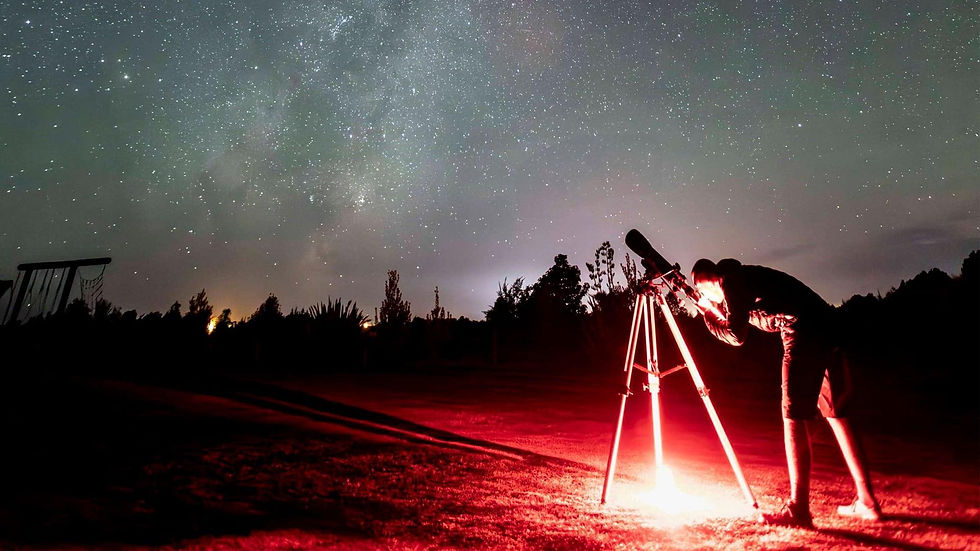
Why Do Astronomers Often Use Red Light?
You may have seen astronomers using dim red torches rather than bright white ones.
There is a reason.
The rod system that is so important for night vision is relatively less sensitive to longer-wavelength red light than to some other visible wavelengths.
A suitably dim red light can therefore allow someone to see what they're doing while causing less disruption to their dark-adapted rod vision than a bright white light.
That doesn't mean red light has no effect at all — brightness still matters — but it explains why dim red illumination has traditionally been useful for astronomy.
Does Your Peripheral Vision Help in the Dark?
Yes — and this links directly to another of our Science of Seeing articles.
Rods aren't distributed evenly across the retina.
The very centre of our vision — the fovea — is packed with cones and has essentially no rods.
More rods are found away from the very centre.
That's why, in very low light, a faint object can sometimes become easier to detect if you look slightly to one side of it rather than directly at it.
Astronomers even use this deliberately. It's known as averted vision.
We've explored this in more detail in:
Try Dark Adaptation Yourself
You don't need any special equipment to experience this.
Tonight, when it's dark, try this simple experiment.
Go into a safe room and switch off the lights.
At first, notice how little detail you can see.
Don't look at your phone.
Wait for a few minutes.
Gradually, you'll probably begin to make out shapes and objects that were initially difficult or impossible to see.
Wait longer and you may notice further improvement.
Nothing in the room has changed.
The amount of light hasn't magically increased.
The change is happening within your own visual system.
Then briefly turn on a bright light — taking care to move around safely — and switch it off again.
You'll immediately appreciate just how much your eyes had adapted.
Do Our Eyes Adjust to Bright Light Too?
Yes.
Visual adaptation works in both directions.
If you leave a dark cinema and step outside into bright sunshine, the opposite problem occurs.
For a moment, the light can feel overwhelmingly bright.
Your pupils constrict and your visual system adapts to the much higher light level.
This light adaptation generally occurs more rapidly than complete dark adaptation.
So your eyes and visual system are constantly adjusting themselves to suit the world around you.
Does Dark Adaptation Change as We Get Older?
Our ability to see in low light can change with age.
Changes within the eye can reduce the amount or quality of light reaching the retina, and the visual system's ability to adapt to darkness can also become slower.
This is one reason some people notice that driving at night becomes more challenging as they get older, even when they can still read the eye-test chart well in normal lighting.
Cataract, changes in contrast sensitivity and other eye conditions can also affect vision in low-light situations.
If you've noticed a significant or new deterioration in your night vision, it's worth mentioning during your eye examination rather than simply assuming it's an inevitable part of ageing.
When Is Poor Night Vision Worth Checking?
Taking some time to adjust to the dark is completely normal.
However, there's a difference between normal dark adaptation and a significant change in your ability to see in low light.
If you notice that your night vision has become noticeably worse, you're struggling much more than previously in dim conditions, or one eye seems significantly different from the other, it's sensible to discuss it with your optometrist.
A change in night vision can have several possible explanations, and an eye examination can help determine whether further investigation is appropriate.
Your Eyes Are Constantly Adapting
We rarely notice just how extraordinary our visual system is.
Walk from bright sunshine into a dark building and your eyes adapt.
Turn the lights off at bedtime and they adapt again.
Step back into daylight and another series of adjustments begins.
Your pupils are changing size, your retina is responding to different light levels, and your rods
and cones are altering the way visual information is detected.
So next time you turn off the lights and initially can't see anything, give it a moment.
The room isn't getting brighter. Your eyes are getting better at seeing the darkness.
And that's another remarkable example of the Science of Seeing.
More From Our Science of Seeing Series
Discover More About the Science of Seeing
Our eyes and brain perform remarkable tricks every day without us even noticing.
Explore the Science of Seeing→ Link to your Science of Seeing Wix category.

Comments